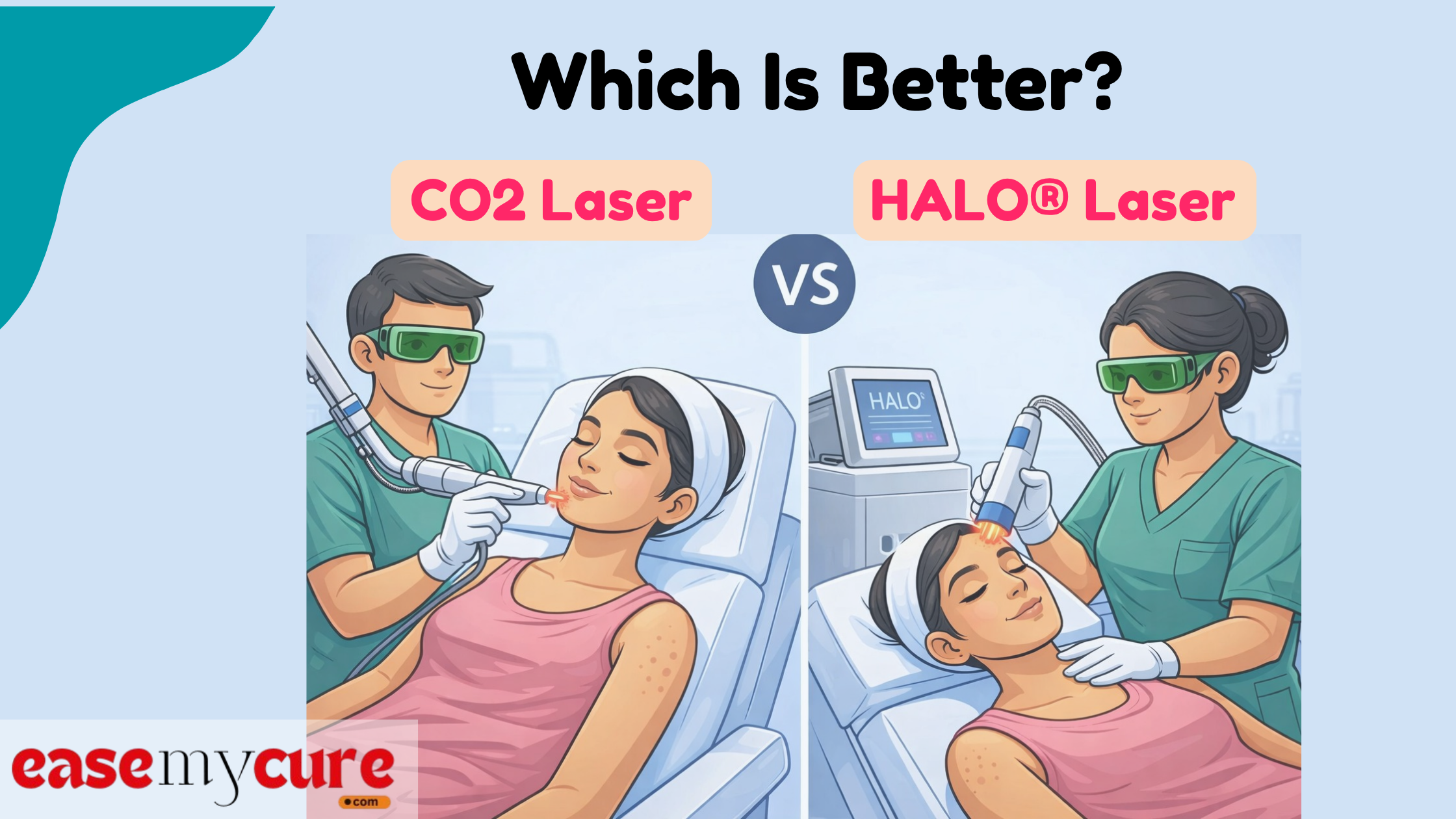

Choosing a laser treatment for your skin is rarely a casual decision. It comes after months, sometimes years, of dealing with acne scars, pigmentation, fine lines or uneven texture. In India, where aesthetic awareness is growing rapidly, many people find themselves comparing CO2 laser resurfacing with newer options like the HALO laser treatment.
But the better question is not "Which one is superior?" It is: Which is right for my skin, my tolerance for downtime and my long-term goals? Aesthetic regret is not a result of poor technology, but in fact is often due to mismatched expectations.
Understanding What Each Laser Actually Does
Before comparing results, it is good to understand how these technologies work. The names may sound similar but their mechanisms, and recovery journeys, can be quite different.
What Is CO2 Laser Resurfacing?
CO2 laser resurfacing is an ablative laser treatment. This means that it removes thin layers of skin tissue by using concentrated light energy from carbon dioxide. Modern fractional versions produce microscopic columns of controlled injury without damaging the rest of the tissue, in order to facilitate healing.
It is commonly used for:
- Deep acne scars
- Pronounced wrinkles
- Sun damage
- Surgical scars
- Severe textural irregularities
Because it works by vaporising the damaged skin layers, CO2 laser resurfacing stimulates significant collagen remodeling within the dermis. Clinical studies have shown that fractional CO2 lasers can produce measurable improvements in atrophic acne scars and skin texture by creating controlled microthermal injury zones that trigger collagen regeneration. The results can be dramatic, but so is the downtime. Redness, swelling, peeling, and social recovery of 7–14 days (occasionally longer for deeper settings) are common.
What Is HALO Laser Treatment?
The HALO laser treatment is known as a hybrid fractional laser, combining ablative and non-ablative wavelengths in one session. In simple words, it acts at the surface and at the deeper layer of the skin, but it does not completely remove the top layer, as in the case of traditional ablative lasers.
It is generally used for:
- Mild to moderate pigmentation
- Fine lines
- Enlarged pores
- Early acne scarring
- Uneven tone
Since some of the treatment is non-ablative in nature, there tends to be a shorter recovery. Most patients feel redness and slight swelling for a couple days followed by a sandpaper-like texture as skin is renewed. The improvement is usually very slow and may require many sessions. It is less aggressive than full CO2 laser resurfacing, which makes it appealing, but also means expectations must be realistic.
Why the “CO2 vs HALO Laser” Question Can Be Misleading
When patients compare CO2 vs HALO laser, they often assume both serve the same purpose at different intensities. That is not quite true as CO2 lasers are oftentimes corrective. HALO treatments in many cases are made preventive or moderately corrective. One is not necessarily better than the other and they are located on various points on the intensity spectrum. Choosing the wrong one has less to do with technology and more to do with wrong-fit goals.
Risks, Downtime, and Long-Term Thinking
Laser surgery decisions are often made based on "before and after" photographs. But rarely there are photos of the healing phase, the discomfort, the emotional experience of recovery.
CO2 Laser Benefits and Risks
The CO2 laser benefits and risks must be weighed together, not separately.
Potential benefits:
- Significant collagen stimulation
- Noticeable improvement in deep scars
- Long-lasting results
- Fewer sessions required compared to lighter lasers
Potential risks:
- Extended downtime
- Persistent redness for weeks
- Post-inflammatory hyperpigmentation (especially in Indian skin tones)
- Infection risk if aftercare is poor
- Temporary demarcation lines between treated and untreated areas
For someone with deep acne scars who is mentally and practically prepared for downtime, CO2 laser resurfacing can be transformative. Clinical research and meta-analyses have shown that fractional CO2 laser treatments can significantly improve atrophic acne scars, with many patients experiencing visible scar reduction and improved skin texture after a series of sessions.
For someone with a busy schedule, low pain tolerance or social commitments, the same treatment can be overwhelming.
HALO Laser: Gentle Does Not Mean Risk-Free
The HALO laser treatment is often marketed as “minimal downtime.” While healing is usually shorter, it is still a medical procedure.
Common considerations include:
- Temporary redness and swelling
- Micro-crusting
- Uneven peeling
- The need for multiple sessions
- Maintenance treatments
As results are gradual, some patients underestimate the number of sessions that they may require. That can result in unexpected accumulation of costs and discontent and that is not because the technology did not work, but because expectations did not match.
Cost vs Outcome Thinking in India
In India, pricing for fractional laser treatments varies widely based on city, practitioner expertise, machine generation, and depth settings. CO2 laser resurfacing may seem more expensive per session, but often requires fewer sittings. HALO treatments may cost moderately by the session but repetition is necessary.
Instead of asking “Which is cheaper?”, consider:
- How many sessions will realistically be needed?
- How much downtime can I afford professionally?
- Am I mentally prepared for visible peeling?
- Am I choosing this before a wedding or event deadline?
Cost regret is a common occurrence when the patients only pay attention to the price of a single session rather than look at the overall treatment plan.
When to Pause and Reconsider Before Choosing
Laser resurfacing isn't just a technical choice but also a psychological one. Before deciding between CO2 laser resurfacing and a hybrid fractional laser, pause and reflect on the following:
- Are your expectations realistic medically?
Lasers are an improvement in scars and texture but cannot produce poreless, filter-like skin. - Are you comparing yourself to Photoshopped social media pictures?
Many results that can be found online have been photographed under controlled lighting. - Are you in a hurry due to the deadline of an event?
Healing timelines are unpredictable. Skin may fail to cooperate with scheduling. - Do you know the entire process of recovery?
This involves the strict avoidance of sun exposure, changes in the skin care, and potential discomfort. - Have you ever thought of your skin type?
Indian skin tone is more likely to be prone to pigmentation changes post aggressive procedures. - Are you ready for maintenance?
Collagen stimulation slows down once again with age. No laser freezes time. - Are you emotionally ready for crisis worsening for a time?
Skin often appears worse before it gets better.
Many aesthetic regrets occur because patients have chosen intensity without considering skin readiness. More aggressive is not always smarter. Gentler is not necessarily always sufficient.
Long-Term Consequences People Rarely Discuss
Repeated aggressive treatments can cause the skin to become thinner over time if not done at an appropriate interval. Over-treatment is a problem in the urban aesthetic field that is not widely discussed. Similarly, undertreatment of deep scars with mild treatments may result in frustration and spending escalation.
Another factor that is overlooked is pigment memory. And once skin develops post-inflammatory hyperpigmentation, it may take months to fade. Preventing that risk often is more important than striving for rapid improvement. Laser decisions need to be made with a long-term lens, and not a short-term aesthetic impulse.
So, Which Is Better For You?
There is no universal winner in the CO2 vs HALO laser discussion.
CO2 laser resurfacing is often better for:
- Deep, well-established scars
- Significant textural damage
- Patients prepared for downtime
- Those seeking more dramatic correction in fewer sessions
HALO laser treatment may be better for:
- Early aging concerns
- Mild to moderate pigmentation
- Patients wanting shorter recovery
- Those comfortable with gradual improvement
The right choice depends on severity, tolerance, timing, skin type, and psychological readiness.
Make the Right Laser Choice for Your Skin Type
Aesthetic treatments should never feel like a gamble. Whether considering CO2 laser resurfacing or a hybrid fractional laser, the goal is not to chase trends, but to align technology with personal reality.
At EaseMyCure, the emphasis is not on pushing procedures, but on helping individuals think clearly before they decide. When a treatment choice feels informed, realistic, and pressure-free, the outcome, whatever it may be, is far less likely to bring regret.
Check This Blog Also:- Top 10 Laser Hair Removal Clinics in Delhi, India
Frequently Asked Questions For CO2 or HALO