
Fractional CO₂ Laser vs. Traditional CO₂ Laser: Which is Better and Why?
Have acne, scars, or uneven tone got you frowning about where that natural glow in your skin disappeared? Well, you might just need pure and safe skin cleansing. And the right choice of laser skin treatment can do it better than any fairness cream or glow serum.
CO₂ lasers are among the most popular skin rejuvenation techniques in today’s time. You can choose between a traditional CO₂ laser or a fractional CO₂ laser. But making the right choice is critical. While both can get you dramatic skin renewal, they work very differently, come with different recovery timelines, and suit different skin concerns.
This blog can solve your confusion. By the end, you’ll have a clear, practical understanding of how each treatment works, who it’s best for, and how to choose the safer, smarter option for your skin goals.
What is CO₂ Laser Resurfacing?
Laser surfacing with CO₂ is a skincare treatment that removes damaged outer layers of the skin and encourages collagen production in the deeper layers. Through this method, the skin gets a “controlled injury”, so that when it heals, it feels firmer and smoother, and has a more even tone.
The science behind this method is simple: collagen, which makes the skin firmer, begins to decline after your mid-20s, reducing by around 1% every year. Laser resurfacing makes the skin start its natural repair process and produces fresh elastin and collagen.
This process has two major types, namely, traditional and fractional CO₂ laser treatment, and it’s important to choose the type that works best for you.
Traditional CO₂ Laser Treatment
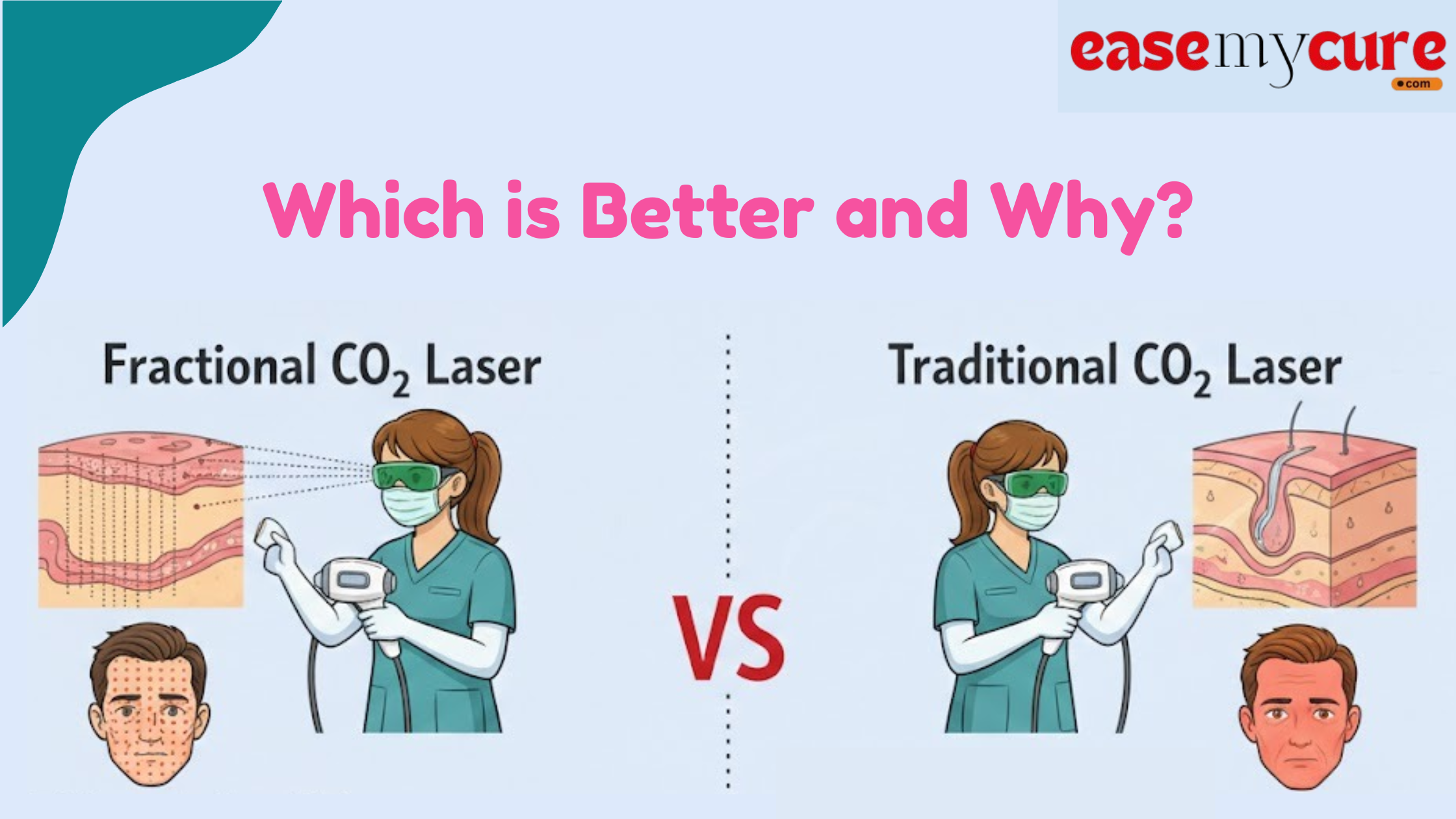
The original form of CO₂ laser technology has a single and continuous laser beam removing the surface layer of skin, known as the epidermis. Thus, it is a complete reset of your damaged skin.
A traditional laser can fetch results beyond your expectations as it treats the skin surface uniformly. This is especially true for intense skin damage problems like severe acne scarring, advanced sun damage, or deep wrinkles.
So, if it’s an extreme case, traditional CO₂ lasers are the gold standard. But there is a major trade-off here.
The treatment acts on the entire skin surface and can’t be used with high precision, which is why it heals slowly. You may experience crusting, oozing, swelling, and redness for quite a few weeks. The part of the skin that’s treated can take 4-6 weeks to recover, and it might retain the redness for months.
There is also a higher risk of complications with traditional CO₂ lasers. Patients may experience post-inflammatory hyperpigmentation, prolonged redness, and scarring if they don’t follow the right steps for aftercare.
You should opt for a CO₂ laser only when:
- Skin damage is severe.
- You have tried other treatments but haven’t got results.
- You can afford significant downtime.
- A highly experienced dermatologist performs the procedure.
In case you juggle work, social life, and daily responsibilities, this level of downtime can be a deal-breaker.
Fractional CO₂ Laser Treatment
Fractional technology was developed to solve exactly the problems that traditional CO₂ lasers can’t solve.
Instead of removing the whole skin surface, a fractional CO₂ laser applies laser energy in thousands of tiny micro-columns to treat the exact affected area. This way, the surrounding skin is untouched and acts as the healing source, making the target area of the skin recover faster.
Your skin gets a similar collagen boost without the post-treatment discomfort.
Fractional CO₂ lasers can reduce pigmentation, wrinkles, acne scars, and issues in skin texture. You are likely to experience light post-treatment effects like mild swelling and redness, followed by light peeling.
At the same time, it cuts the recovery span by more than 50%, as the treated area generally takes about 5-10 days to heal. That’s why this technique is a great fit for working professionals.
Another benefit is that it’s safe for all skin tones. Fractional treatment injures less skin at once, which is why pigmentation issues are less likely when specialists use the right settings.
Most people prefer fractional CO₂ lasers for:
- Acne scars and post-acne marks
- Fine lines and early wrinkles
- Uneven texture and enlarged pores
- Visible results without extended time for recovery
Comparing the Two Laser Treatments
When deciding between these treatments, a side-by-side laser resurfacing comparison helps cut through the noise. Let’s break it down based on the factors that actually matter to patients:
Treatment Depth and Precision
Traditional CO₂ lasers treat the entire surface uniformly, which means deeper penetration but less control. Fractional technology allows dermatologists to fine-tune depth, density, and intensity based on individual skin concerns.
Notably, till the early 2000s, people had to choose between highly aggressive treatments that came with long recovery times and gentle ones which didn’t fetch the desired results. When fractional CO₂ lasers were introduced, they changed this trend by balancing intensity with effective results.
Precision is important, especially for more targeted problems like acne scars or pigmentation.
Downtime and Recovery
A key deciding factor is the time it takes for the affected area to recover.
For a traditional CO₂ laser treatment, you can expect the recovery time to be several weeks. Moreover, it’s important to avoid contact with sunlight and care for the wound the right way to make sure the area heals properly.
Thus, if you need to step out of your home often, getting the right results can be difficult. But with a fractional treatment, you can return to your normal routine within a week.
Results and Longevity
A traditional treatment may deliver slightly more dramatic results in a single session. However, you can often get comparable results with a fractional treatment over multiple sessions. Collagen remodelling continues for months after both procedures, meaning results improve gradually over time.
Safety and Side Effects
Traditional lasers are more prone to infections, scars, and pigmentation changes. Treating the exact area that’s affected can reduce these risks to a great extent, especially for Indian and darker skin tones. According to dermatologists, fractional lasers are now considered safer for a broader patient population.
Cost and Accessibility
Traditional CO₂ lasers are generally more costly than fractional CO₂ lasers as they need anaesthesia, a longer time for the treatment session, and stricter care afterwards.
In India, the cost of fractional CO₂ lasers ranges from ₹3,000 to ₹15,000 per session, based on the city, treatment area, and clinic. As for a traditional treatment, it can cost between ₹8,000 to ₹50,000 depending upon the size of the area, the sessions required and the type of technology used.
Final Takeaway
Choosing between a traditional CO₂ laser vs fractional CO₂ laser treatment isn’t about which treatment is “better” on paper; it’s about which one is right for your skin, lifestyle, and recovery tolerance.
If your concerns are mild to moderate and you want visible improvement without weeks of downtime, fractional CO₂ laser treatment is usually the smarter, safer choice. Traditional CO₂ lasers, on the other hand, still hold value for severe, deeply damaged skin, but only when downtime, aftercare, and expert supervision aren’t limiting factors.
Why rely on assumptions or generic tips? With EaseMyCure, you can compare trusted clinics, see clear pricing upfront, and speak to qualified experts who prioritise your skin, not what’s popular. Book your consultation today.