
PRP is one of the most hyped hair treatments in India right now and science is actually more promising than many people realise. The invigorating fact about PRP therapy hair loss India is this: unlike most of the treatments available to desperate hair-loss patients, PRP does have peer-reviewed clinical research support, not before-and-after photos on websites of hair loss clinics. In the last five years, Platelet rich plasma hair treatment has become part of mainstream Indian dermatology clinics, rather than being an experimental treatment. However, it is no magic panacea and how precisely it can and cannot work is the key to realistic outcomes and money down the drain.
What Is PRP Therapy for Hair Loss and How Does It Work?
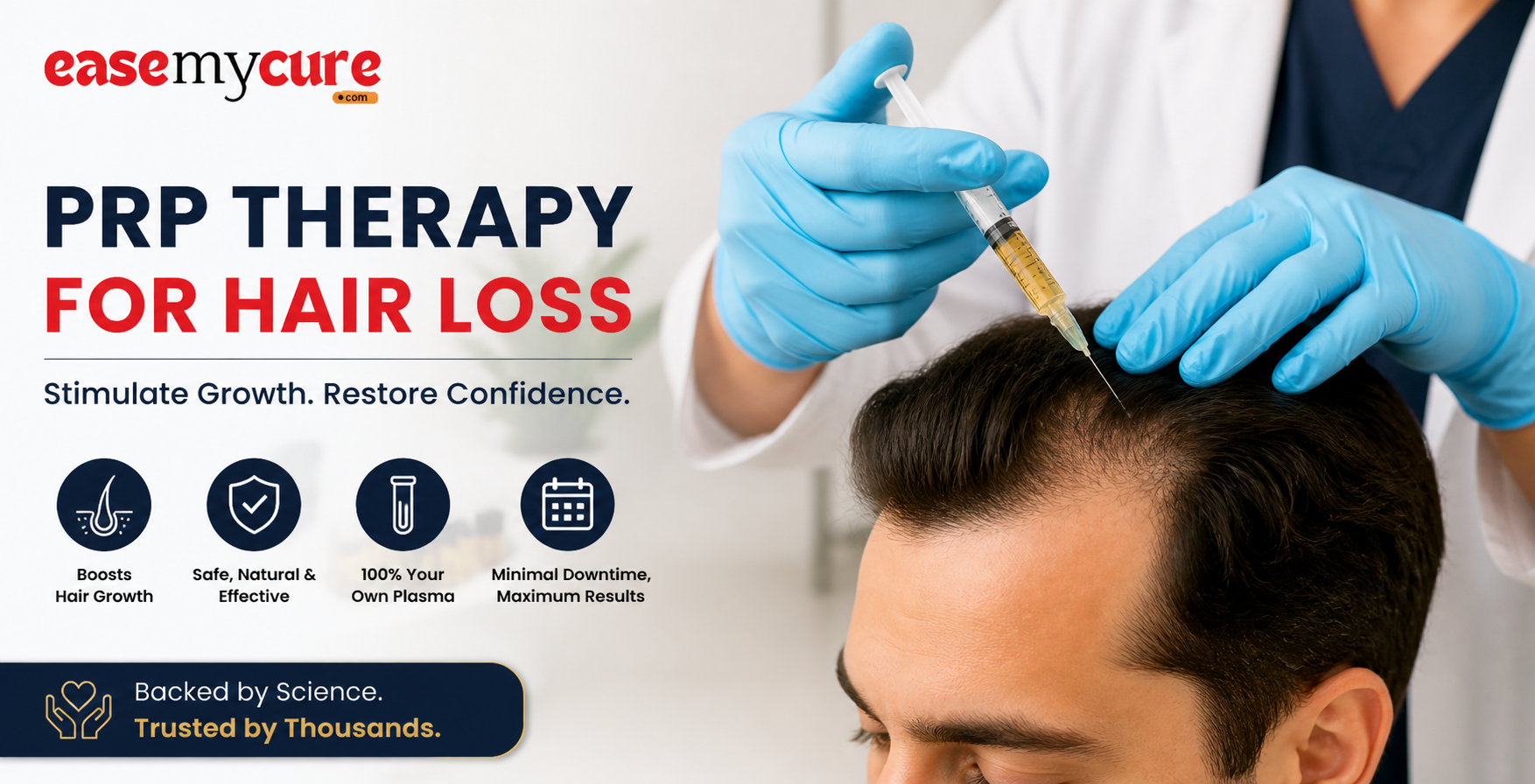
PRP (Platelet Rich Plasma) is not a very complicated sounding process but the process is an elegantly simple mechanism. A little blood (approximately, 20-30 ml) is taken out of your arm just like a normal blood test. The blood then is put in a high-speed centrifuge machine, which splits it into three layers: red blood cells, platelet-poor plasma and the golden middle layer, platelet-rich plasma.
This focussed plasma is full of platelets 5-8 times higher than the normal amount in blood. Platelets do transport potent growth factors, such as PDGF (Platelet-Derived Growth Factor), VEGF (Vascular Endothelial Growth Factor) and TGF-b (Transforming Growth Factor-beta).
These growth factors induce the dormant follicle cells once they are injected into the head at the position of the hair follicles in the dormant cells and back into the active (anagen) growth phase.
They too enhance blood flow to the follicle as well as slow down the miniaturisation process which causes androgenetic alopecia, the most widespread form of hair loss in India. This kind of procedure lasts between 45 and 60 minutes, no anaesthesia is required, but usually a numbing cream is used prior to the operation.
What the Research Says Clinical Evidence for PRP
The PRP hair loss results have increased in their evidence-base. In a 2025 systematic review and meta-analysis in PubMed, of 43 randomised controlled trials (1,877 participants), PRP was found to have a moderate amount of evidence suggesting that it is both safe and effective in increasing hair density and reducing hair loss.
In another 2024 meta-analysis research in Aesthetic Plastic Surgery, the authors found that the PRP group had a significantly higher hair density compared to the control group with a mean difference of 25.09 hairs/cm².
Another pivotal placebo-controlled study by the University of Rome demonstrated that patients receiving only three PRP treatments increased the number of hairs in the target region by an average of 33.6 and an increase in the total number of hairs per cm² by 45.9.
In clinical studies, patient satisfaction scores are always rated above 7 out of 10 with about 96 percent of the patients in one of the studies reporting some clinical improvement.
The general regimen in most trials is 3-6 sessions with a 4-6 weeks interval in between and then, maintenance sessions after every 6-12 months. The results can be expected to be evident in 3-6 months of the treatment.
Research Snippet: In one South Asian study, a 2024 Oxford Academic systematic review discovered PRP was found to be superior over topical minoxidil in terms of patient satisfaction rate (PRP 100 vs. minoxidil 69), and negative hair pull test rate (PRP 100 vs. minoxidil 91).
Important: PRP is not approved by the FDA to treat hair loss. Although the evidence in clinical settings is encouraging, heterogeneity of studies implies that the results may be different. It is recommended to seek the advice of a trained dermatologist prior to treatment.
Who Is PRP Best Suited For?
PRP can be effectively used when the follicles remain alive. PRP can stimulate and re-activate existing follicles, but it does not make new follicles. When a follicle is too long dormant or is totally destroyed, no growth factors will help to bring it back to life.
The perfect PRP candidate has to be in the beginning or middle stages of hair loss, normally Norwood Scale I–III among men, Ludwig I–II among women. Individuals who are androgenetic alopecia (pattern baldness/thinning), diffuse hair thinning or respond to stress (telogen effluvium) respond optimally. Hormonally-induced hair loss women are also good candidates as the clinical data indicates that this group has an 80-90 percent benefit rate.
PRP is also becoming more popular as an after-hair-transplant maintenance agent, injected into the area of the recipient to enhance graft survival rates and speed up recovery.
Not ideal for: PRP is not ideal in those with a totally bald scalp, active scalp infections, blood clotting disorders, those on anticoagulants or those with autoimmune alopecia areata (PRP has little evidence of this type). The response rate of heavy smokers is also lower because nicotine affects the platelet in a way that it reduces its functionality.
PRP vs Hair Transplant When to Choose Which?
This is among the most inquisitive enquiries in Indian hair salons and the solution is: they resolve various issues. It is not a PRP vs hair transplant race, they are a means to the various phases of hair loss.