
The silent hair loss epidemic among females has reached a crucial point in the sub-continent, as research shows that hair loss is affecting nearly one out of every three women in India. In spite of this shocking statistic, the topic of hair transplant treatment for women in India still remains largely gender biased.
Hair is essential to the modern Indian woman as an emblem of her physical well-being and individuality; thus, any enlargement of the hair line is likely to result in severe emotional trauma. Fortunately, recent changes in technology have introduced novel, “no-shave” methods that are uniquely suited to treat female pattern baldness.
Female Pattern Baldness vs Male Pattern Baldness - Key Differences
The differences between men’s and women’s hair loss need to be well understood before considering surgery. Male pattern baldness or MPHL usually occurs in a predictable, localized fashion on the scalp and vertex of the head and is classified according to the Norwood-Hamilton Scale.
Unlike that, Female Pattern Hair Loss (FPHL) is associated with the diffused hair thinning on the scalp's upper and crown region without altering the frontal hair line, a condition that can be determined using the Ludwig Scale. In men, DHT sensitivity is the main motivator, whereas women are caught up in a hormonal landscape.
In India, FPHL is a multi-dimensional problem, often caused due to conditions such as PCOS, problems in the functioning of the thyroid gland, or long-term lack of vitamins and iron from one's diet. In clinical studies, it was found that 71 percent of Indian women suffer from partition widening. Partition widening takes place in a very aggressive manner in view of stress-induced lifestyles.
Why Women Are Different Candidates for Hair Transplant
In the case of female patients, the criteria for success are considerably stricter. The “safe donor zone” on the scalp of males is generally resistant to hair loss. Since the majority of females suffering from FPHL have diffuse hair loss extending into the “safe donor zone,” the follicular unit transplantation procedure cannot be performed successfully on many female patients.
Another significant distinguishing factor is that between Diffuse Patterned Alopecia (DPA) and Diffuse Unpatterned Alopecia (DUPA). Individuals suffering from DPA, in whom there is a good donor supply in the occipital region, tend to be ideal candidates for the procedure. In contrast, with DUPA, there is diffuse thinning all over the scalp, rendering transplantation pointless.
Moreover, hair transplant surgery in women is dependent on "density enhancement" as opposed to the conventional method of creating a hairline. This delicate procedure needs immense skill to successfully embed new hairs in between existing hairs without causing harm to the native hair, which can lead to "shock loss."
Contrary to male-pattern surgeries, the aim in this case is to cover up thin patches in the middle of the scalp and the back. It requires the maintenance of a healthy donor environment alongside a strategic increase in follicular size. If done right, the results can be quite natural-looking as well as confidence-restoring, especially when the causes are also addressed.
The Best Hair Transplant Techniques for Women - FUE vs DHI
India’s technological advancement has shifted gears to tackle the foremost worries that females have – privacy and retention of their long hair. Though traditional FUE technique works well, it demands the removal of hair from the scalp, an aspect which women detest.
DHI stands out as the better hair restoration technique for women with hair loss problems. The DHI procedure uses the Choi Implanter Pen, where doctors plant hair follicles without making incisions on the scalp. This one-step procedure provides:
- No-Shave Feasibility: High precision placement between existing long hairs.
- Higher Survival Rates: Reduced "out-of-body" time for follicles, reaching 90-95% viability.
Faster Recovery: Minimized trauma to the scalp compared to traditional methods.
Who Is and Is Not a Good Candidate - Female Hair Transplant Criteria
Candidacy is decided by a series of clinical tests. In an optimal situation, the female patient should have hair thinning resulting from mechanical causes, such as traction alopecia.
Positive Indicators for Surgery:
- Hair loss stabilized for 12–24 months.
- A donor density of at least 65 to 80 follicular units per square centimeter ($FU/cm^2$).
- Controlled hormonal levels (Thyroid/PCOS).
Negative Indicators:
- DUPA: Miniaturization across the entire donor area.
- Autoimmune Conditions: Disorders like Alopecia Areata, where the immune system attacks follicles.
Unstable Hormonal Flux: Being less than 12 months postpartum or having active, untreated thyroid issues.
Cost of Female Hair Transplant in India
India happens to be one of the largest centers for hair restoration worldwide. It offers top-quality surgical services at much lower costs compared to the West. The price of hair transplant for women in India mainly depends on the number of grafts required. As of 2025, the average cost per graft varies from ₹25 to ₹50.
Typically, women require fewer grafts than men-often 1,500 to 2,500 focused on the central part line.
- 1,000 Grafts: ₹30,000 – ₹50,000 (Early stage)
- 2,000 Grafts: ₹50,000 – ₹1,00,000 (Moderate thinning)
- 3,000 Grafts: ₹80,000 – ₹1,50,000 (Significant widening)
To improve accessibility, most Indian clinics offer EMI options, with payments starting as low as ₹2,777 per month.
Women's Hair Transplant Results - What to Realistically Expect
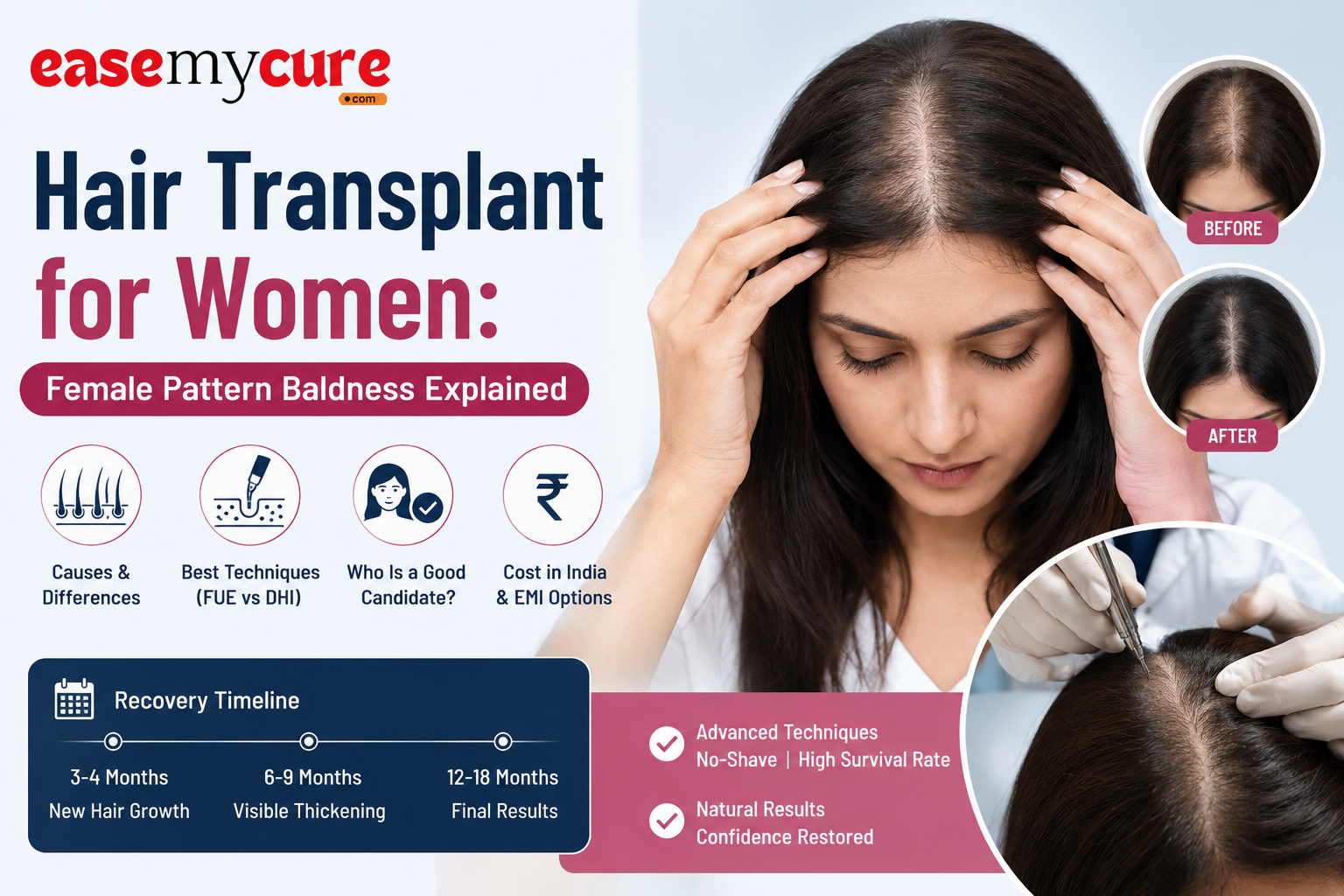
However, patience is required because the biological process will take up to 12 to 18 months. The patients go through a period of shedding after the treatment. This is expected it’s just a reset for the follicles.
The Recovery Roadmap:
- Months 3-4: New, fine "baby" hairs begin to emerge.
- Months 6-9: Significant thickening occurs; the part line begins to fill in.
- Months 12-18: The final, permanent result is achieved.
Long-term hair growth for women procedures, such as PRP or GFC treatments, need to be done on a half-yearly basis to preserve the health of the native hair.